- Pace
- For a first visit, do Montréal plus Québec City and Charlevoix over about 7–9 days, using the train between the cities and renting a car only for the countryside. Montréal–Québec City is about 270 km and roughly 3½ hours by train, but Québec City–Gaspésie is about 694 km before the peninsula loop begins; treat Gaspésie as a separate 9–14-day car trip, and the Îles-de-la-Madeleine as its own 5–7-night island stay.
- When to go
- June–September is the easiest window for a first trip: every road-trip service, whale boat, ferry and park is operating, but book coastal rooms well ahead. September and early October are the strongest compromise for food, hiking and foliage, with fewer festival crowds than high summer. Winter is excellent if you are deliberately coming for snow, skiing or Québec City’s Carnival; spring is cheaper and maple-rich, but muddy, erratic and unreliable for rural touring.
- Daily budget
- C$300–500
Québec is a French-speaking, St. Lawrence-shaped region on a country-sized scale: Montréal and Québec City anchor its southwest, while the road east and north leads to farm country, fjords, whale water, sea cliffs and genuinely remote coasts. Come for the two cities’ very different versions of Québécois culture, then for maple, dairy, seafood and outdoor landscapes—but do not mistake it for a compact province break.
Known for
- Montréal’s food, neighborhoods, museums and nightlife
- Québec City’s walled old town and riverfront history
- Maple-season food, poutine, smoked meat, bagels, cheese, cider and cold-climate wine
- Charlevoix food country and St. Lawrence scenery
- Tadoussac whale watching and the Saguenay Fjord
- Gaspésie, Percé and the Îles-de-la-Madeleine’s maritime landscapes
Where to go
 1
Base · 1–3 days
Montréal
Québec’s strongest urban stop: neighborhoods, museums, markets, late dinners and a food scene that goes far beyond poutine. Spend at least three full nights; it works well without a car.
first-timersfoodiesculture travelersnightlife
Explore Montréal Québec City
2Québec City
Base · 1–3 days
The compact historic counterweight to Montréal, with fortified streets, river views and a distinctly Francophone feel. Use it as the base for Old Québec, Montmorency Falls and Île d’Orléans rather than treating the old town as a one-afternoon stop.
first-timershistory loversarchitecture fans
Charlevoix
3Charlevoix
Base · 2 days
The best countryside extension from Québec City: river roads, mountain backdrops, food producers and practical bases in Baie-Saint-Paul or La Malbaie. Rent a car and stay overnight rather than trying to squeeze it into a day trip.
foodiescouplesscenic drives
Tadoussac
4Tadoussac
Base · 2 days
The practical whale-watching base where the Saguenay meets the St. Lawrence, with boat trips, dunes and fjord-scale scenery. Give it one or two nights; it is too far from Québec City for a sensible day trip.
wildlife travelersfamiliesfirst-time whale watchers
Saguenay Fjord and Lac-Saint-Jean
5Saguenay Fjord and Lac-Saint-Jean
A deeper nature-and-culture detour combining fjord cliffs, hiking and kayaking with the agricultural lake country around Lac-Saint-Jean. Base in L’Anse-Saint-Jean or Sainte-Rose-du-Nord for scenery, or Saguenay/Chicoutimi for services.
active travelershikerskayakers
Eastern Townships
6Eastern Townships
Rolling foothills southeast of Montréal, best approached as a slow car weekend of wineries, country inns, hiking and lake villages such as Magog, Sutton and Knowlton. It is more pastoral than dramatic, which is exactly the point.
wine loversfoodiesautumn trips
Laurentians
7Laurentians
Montréal’s easiest lakes-and-mountains escape, with Mont-Tremblant, ski hills and reliable fall color. Skip the resort core if you want quiet; smaller lake towns and park stays are the better bet.
familiesskiershikers
Gaspésie
8Gaspésie
Base · 9 days
Québec’s serious coastal road trip: sea cliffs, small ports, the Chic-Chocs, Forillon National Park and Percé. It needs a car and at least seven nights on the peninsula; anything shorter is mostly driving.
road trippershikerswildlife travelers
Îles-de-la-Madeleine
9Îles-de-la-Madeleine
Base · 6–7 days
A separate Gulf of St. Lawrence trip of dunes, red cliffs, fishing villages and long beaches. Fly in or commit to the ferry logistics, then give it five to seven nights rather than bolting it onto a mainland itinerary.
beach travelerscyclistsseafood lovers
Côte-Nord
10Côte-Nord
Beyond Tadoussac, this is sparsely serviced St. Lawrence country of Baie-Comeau, Sept-Îles, Innu cultural presence and the Mingan Archipelago’s limestone monoliths. Choose it only when you have time for long distances and limited lodging.
second-time visitorsexpedition-minded road trippersremote nature travelers
Don't miss
1
Montmorency FallsCentral Quebec
At 83 metres, the falls are higher than Niagara and make the easiest major nature outing from Québec City. The point is to see them from more than one level—base, bridge, or cable car—not just from the parking area.
2
Dufferin TerraceCentral Quebec
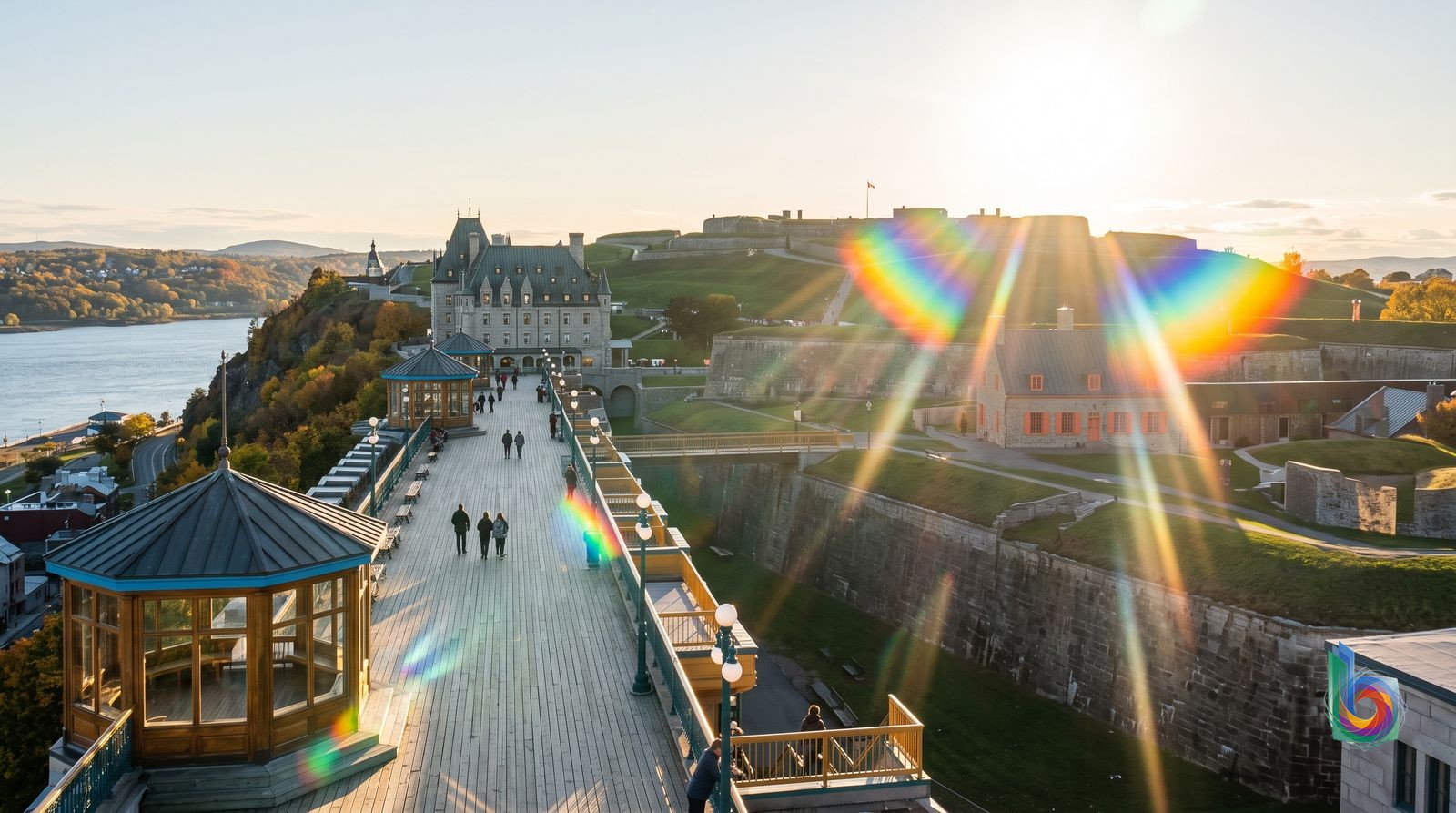
The boardwalk below Château Frontenac supplies the essential St. Lawrence panorama and a useful spine for exploring the upper town. Walk it slowly, then continue to the Citadelle or down toward Petit Champlain.
3
Old QuebecCentral Quebec
North America's most intact walled colonial city is the region's indispensable first visit: fortifications, steep lanes, river outlooks, and French-language urban texture all converge here. Give it at least a half-day on foot, splitting upper and lower town rather than trying to rush both.
4
Fairmont Le Château FrontenacCentral Quebec
The château is the visual shorthand for Québec City, best appreciated as an architectural landmark and viewpoint anchor even if you are not staying there. See its exterior from Dufferin Terrace and lower-town viewpoints; a hotel-history tour adds context for architecture enthusiasts.
5
Parc national de la Jacques-CartierCentral Quebec
This deep glacial valley is the most rewarding major wilderness escape near Québec City, with hikes, canoeing, autumn color, and a genuine sense of scale. It deserves a full day or overnight rather than being squeezed into a city itinerary.
6
Parc national de la GaspésieSoutheastern Quebec
For mountain-scale Québec, this is the essential Gaspésie park: high alpine terrain, serious hiking, moose habitat, and the chance to see caribou. Plan it as a multi-day road-trip stop, with a hike matched honestly to weather and fitness.
Getting your bearings
Numbers match the places above; small dots are the headline sights.
The mental map
Plan Québec in four useful slices: Montréal and the south, including the Eastern Townships and Laurentians; Québec City and the St. Lawrence corridor, including Île d’Orléans and Charlevoix; the north shore and Saguenay, centered on Tadoussac and the fjord; and maritime Québec, meaning Gaspésie, the farther Côte-Nord and the Îles-de-la-Madeleine. The first two make a coherent first trip; the latter regions are dedicated road trips or separate fly-in holidays.
When to go
June–September is the easiest window for a first trip: every road-trip service, whale boat, ferry and park is operating, but book coastal rooms well ahead. September and early October are the strongest compromise for food, hiking and foliage, with fewer festival crowds than high summer. Winter is excellent if you are deliberately coming for snow, skiing or Québec City’s Carnival; spring is cheaper and maple-rich, but muddy, erratic and unreliable for rural touring.
Pacing a visit
For a first visit, do Montréal plus Québec City and Charlevoix over about 7–9 days, using the train between the cities and renting a car only for the countryside. Montréal–Québec City is about 270 km and roughly 3½ hours by train, but Québec City–Gaspésie is about 694 km before the peninsula loop begins; treat Gaspésie as a separate 9–14-day car trip, and the Îles-de-la-Madeleine as its own 5–7-night island stay.
Book before you land
Tadoussac whale-watching Zodiac trips in July and August · Île Bonaventure boat crossings from Percé in peak summer · CTMA ferry sailings between Souris, Prince Edward Island and Îles-de-la-Madeleine, especially if taking a car
Getting in
YULMontréal–Trudeau International Airport
The main international gateway and the best arrival point for Montréal, the Eastern Townships, Laurentians, and a Montréal–Québec City trip. It has the most useful international connections and onward domestic flights.
Flights and transfers into MontréalYQBQuébec City Jean Lesage International Airport
Use this for a Québec City, Île d’Orléans, Charlevoix or Tadoussac-focused trip, especially if you do not need Montréal. It is a smaller airport with fewer direct international options.
Flights and transfers into QuébecYGRÎles-de-la-Madeleine Airport
The practical gateway for a dedicated Magdalen Islands trip, usually via Montréal or Québec City. Do not treat the islands as a casual side trip from the mainland.
Before you go
Questions worth settling
How many days do I need for a first trip to Québec?
Allow 7–9 days for Montréal, Québec City and Charlevoix. Montréal deserves at least three full nights, and Charlevoix is best as an overnight car trip rather than a day trip.
Where should I base myself on a first visit?
Base in Montréal for its neighborhoods, museums and food, then stay in Québec City for Old Québec, Montmorency Falls and Île d’Orléans. Add Baie-Saint-Paul or La Malbaie for Charlevoix; use Tadoussac only if whale watching is a priority, for one or two nights.
Can I combine Montréal, Québec City, Charlevoix, Tadoussac and Gaspésie in one trip?
Montréal, Québec City and Charlevoix make a coherent first itinerary, with Tadoussac possible if you have extra time. Do not add Gaspésie casually: it is a separate car trip needing at least seven nights on the peninsula, while the Îles-de-la-Madeleine need their own 5–7-night stay.
Do I need a car in Québec?
No for Montréal and Québec City: both work well without one, and VIA Rail links them in roughly 3½ hours. Rent a car after Québec City for Charlevoix, Tadoussac, the Eastern Townships, Saguenay or Gaspésie, where public transport is not a clean substitute.
What are the entry requirements for Canada?
You need a valid passport. U.S. citizens generally need neither a visitor visa nor an eTA; visa-exempt travelers flying to Canada normally need an eTA, while visa-required nationals need a visitor visa—confirm current rules with Immigration, Refugees and Citizenship Canada before booking.
What is the best time to visit Québec?
June through September is simplest for a first visit, when road-trip services, whale boats, ferries and parks are operating. September and early October are especially good for food, hiking and foliage; winter is best only if you specifically want snow, skiing or Québec City’s Winter Carnival.
What should I book ahead?
For summer, reserve lodging early in Charlevoix, Tadoussac, Percé and the Îles-de-la-Madeleine, especially on weekends. Book Tadoussac Zodiac whale-watching trips in July and August, Île Bonaventure crossings from Percé in peak summer, and CTMA ferry sailings to the Îles-de-la-Madeleine—particularly when taking a car.
Known for
- Montréal’s food, neighborhoods, museums and nightlife
- Québec City’s walled old town and riverfront history
- Maple-season food, poutine, smoked meat, bagels, cheese, cider and cold-climate wine
- Charlevoix food country and St. Lawrence scenery
- Tadoussac whale watching and the Saguenay Fjord
- Gaspésie, Percé and the Îles-de-la-Madeleine’s maritime landscapes


