Season by season
January–mid-April
The dry, reliably sunny winter high season: warm rather than oppressive, with the lowest rain risk. It is also Nassau’s most expensive and busiest stretch.
Hotels and popular excursions cost more; book capacity-limited boat trips and water parks ahead. Spring-break weeks and cruise-ship days make Bay Street and the Straw Market particularly crowded and transactional.
Mid-April–May
The strongest overall compromise: sunshine and warm swimming water, with fewer winter visitors and generally less punishing heat than summer.
Rain and humidity begin to build, and individual cruise-ship days can still overwhelm downtown. Check the port schedule rather than judging crowd levels by your hotel.
June–October
Hot, humid and wetter, with the heaviest rain generally falling in the Northern Hemisphere summer. This is the core of hurricane-season risk.
Showers may be brief, but heat and weather disruption are genuine drawbacks. Build slack into boat-excursion plans and read cancellation terms carefully; tropical systems can disrupt flights, ferries and marine activities.
November
A particularly good shoulder month: the worst summer heat usually eases, water remains warm, and visitor numbers are generally below winter’s peak.
It remains within the official hurricane season, so weather is less certain than in winter. Thanksgiving-period travel can tighten availability and raise prices.
December 1–15
A transition into the dry-season pattern, usually with improving weather before the full winter rush.
Conditions are not as consistently dry as January through early April, and prices can begin rising as the holiday period approaches.
December 16–31
Dry-season high season begins in earnest, with pleasant beach weather and a festive atmosphere.
One of the busiest and priciest periods of the year. Reserve hotels, major excursions and any must-do water-park day well ahead; downtown access and crowds change around Junkanoo.
Events worth planning around
Junkanoo · Usually Boxing Day (December 26) and New Year’s Day (January 1), with major Nassau parades in the early morning; exact operational details vary by year.
Nassau’s defining festival brings major crowds, parade-related road restrictions and strong demand for central accommodation and transport. Stay centrally only if you want to be near the action; otherwise expect disrupted movement around downtown during parade hours.
Spring-break travel period · Usually March through early April, varying with North American school calendars.
Not a single festival, but a consequential annual demand surge: high-season prices stay firm and popular excursions, beach clubs and water parks need earlier booking. Downtown is especially unpleasant when spring-break traffic coincides with several cruise ships.
Cruise-ship port days · Year-round; especially consequential during the winter cruise season. Arrival patterns vary by ship schedule.
A ship-heavy day radically changes central Nassau: Bay Street, the Straw Market and the immediate cruise-port area become crowded. Do the historic core early, then head to a beach, gallery or another planned stop; reserve limited-capacity boat excursions for busy dates.
Getting around
Walking
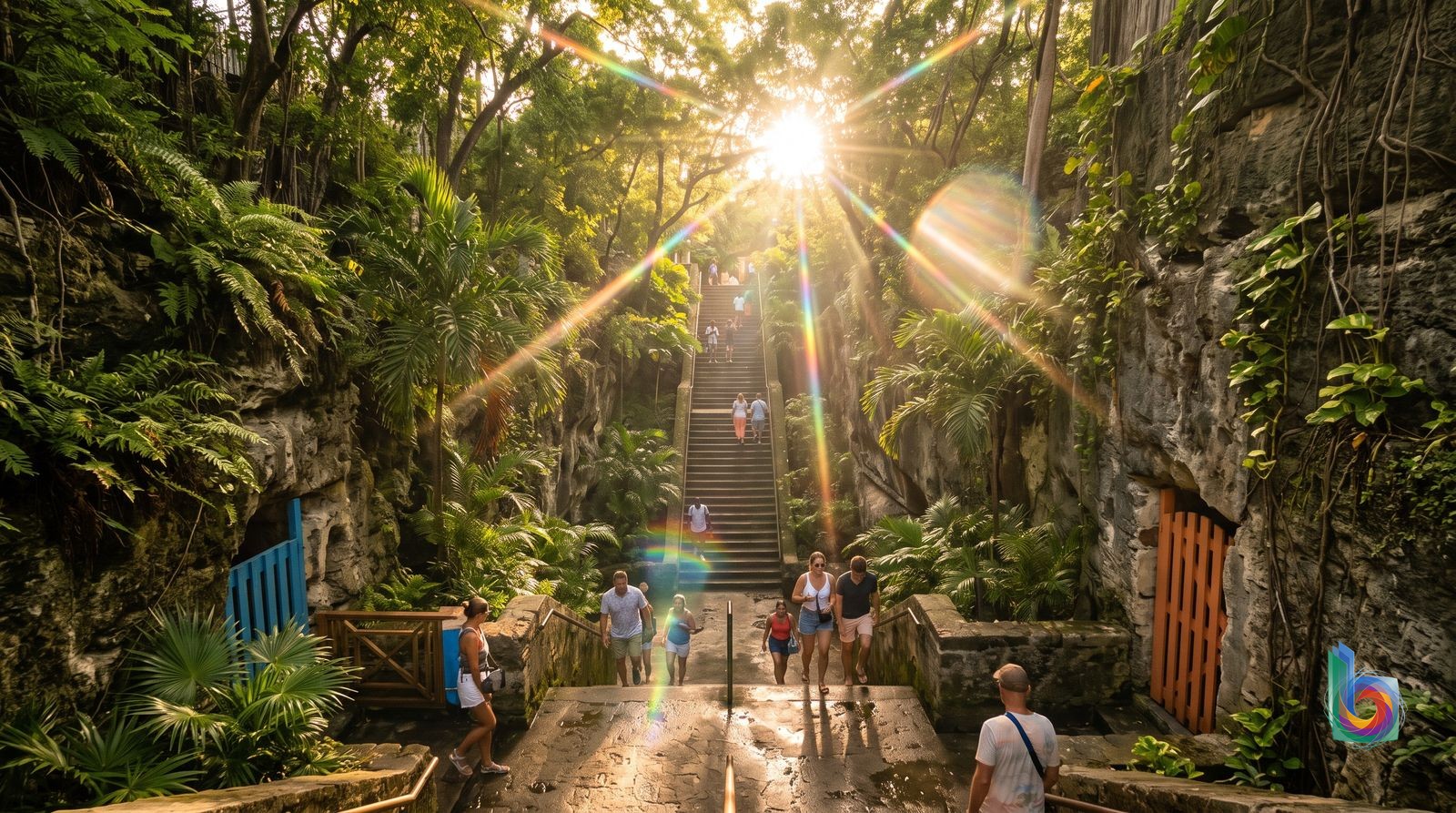
Downtown Nassau & Bay Street: Bay Street, Parliament Square, the Straw Market and the harborfront; add the Queen’s Staircase and Fort Fincastle for a half-day historic walk. A downtown-to-Arawak Cay waterfront walk is feasible by day.
Start early before cruise crowds and heat. Use the walk to connect central sights, then take a taxi for dinner or after dark.
It stops being pleasant on the hill: Fort Fincastle, Bennet’s Hill and Over-the-Hill mean steep climbs, stairs, heat and rough pavements. Do not use an unfamiliar walk through Over-the-Hill/Grant’s Town or the quieter parts of downtown as a nighttime shortcut.
Jitney
The cheap daytime choice between Downtown Nassau and Cable Beach/Baha Mar: routes #10 and #10A run from the George Street/Bay Street area west to Cable Beach. Eastbound routes from Bay Street can help toward the Paradise Island bridge and eastern districts.
Carry exact cash—fares are roughly US$1–2.50—and flag one down or ask the driver whether it goes where you need. Treat route numbers and stops as guidance rather than a timed transit system.
No jitney serves Paradise Island itself, and service generally winds down around 6–7pm, with limited Sunday coverage. Coverage is fragmented for Love Beach/western New Providence and especially South Beach and Yamacraw; it is not a dependable door-to-door or late-night plan.
Licensed taxi
The dependable option after jitneys stop; for Paradise Island, Eastern Road/Montagu, Love Beach and western New Providence; and for dinner at Arawak Cay after dark. It is also the sensible choice for hills, luggage and mobility concerns.
Use licensed yellow-plate taxis only. Agree the total fare before departure—meters are commonly ignored—and confirm that everyone and all bags are included in the quote.
Costs mount quickly, particularly from Love Beach/western New Providence or residential eastern and southern districts. Do not accept rides from strangers or anyone merely claiming to be a taxi.
Water taxi
A scenic daytime link between the downtown harbor area and Paradise Island, useful when the crossing itself is part of the outing rather than a rush-hour necessity.
Check that it is operating before committing to it, and pair it with walking or a taxi at either end.
It generally stops around 6pm, so it is not an evening return option from Paradise Island and not a substitute for a taxi at night.
Rental car
Longer stays based at Love Beach/western New Providence, Eastern Road/Montagu, or South Beach/Yamacraw, where sights, beaches and restaurants are dispersed and taxis would accumulate.
Rent only if you are comfortable driving on the left and will actually explore beyond the downtown–Cable Beach–Paradise Island corridor.
For a short Downtown, Cable Beach or Paradise Island stay, it is more burden than freedom: traffic, parking and left-side driving outweigh the benefit.
Safety: Stay alert after dark—especially south of downtown/Over-the-Hill—use only licensed yellow-plate taxis with the fare agreed in advance, and politely decline unsolicited ride or excursion offers.
Book before you land
Swimming-pigs, Blue Lagoon, reef/snorkelling and similar boat excursions: reserve before arrival in winter, school-holiday weeks and on days when several cruise ships are in port. These are the Nassau experiences with real capacity constraints; choose a reputable operator and check weather/cancellation terms. · Atlantis Aquaventure and Baha Bay water-park admission: book ahead for a specific busy day—especially holidays, weekends and cruise-heavy winter dates—if either is central to your plan. · Do not panic-book the small city sights. Pirates of Nassau, Ardastra Gardens, the National Art Gallery and Fort Fincastle have historically been walk-up-friendly; check current hours instead, since the supplied evidence does not establish routine sell-outs.
- The Bahamian dollar is pegged 1:1 with the US dollar, and US dollars are widely accepted. Carry small bills and exact change for jitneys; drivers may not make change.
- Nassau is pronounced roughly “NAH-saw,” not “Nass-OW.”
- Cruise-ship days transform Bay Street and the Straw Market. Do the historic core early, then move to a beach, gallery or Over-the-Hill cultural stop rather than spending the afternoon in souvenir traffic.
- Treat Over-the-Hill south of downtown with more caution after dark, and use licensed yellow-plate taxis only. The practical risk is not just petty hassle: armed robbery and ride scams are documented concerns on New Providence.
- A polite, firm “no, thank you” is the right response to unsolicited taxi, hair-braiding, marijuana, jet-ski or booze-cruise pitches. Do not let someone ‘helpfully’ steer you into an unlicensed excursion.
- Do not buy supposed Cuban cigars from market sellers; counterfeits are common.
Worth leaving the city for
Exuma Cays — swimming pigs and reef day tourVery full day: typically 9–12 hours door to door from Nassau, including hotel/port transfers and boat or flight logistics.
This is the one splurge that can genuinely eclipse a second day in Nassau: unreal shallows, cays and reef water rather than another lap of Bay Street and the cruise-port zone. Go for the sea, not the pigs—the famous stop is crowded and highly staged. It is expensive, weather-dependent and a long day, so skip it if you dislike speedboats or have only a short cruise call.
Blue Lagoon IslandHalf to near-full day: allow 5–7 hours from downtown once ferry check-in, crossings and return transfer are included.
A straightforward escape for a proper beach-and-water day close to town: calmer, clearer water and snorkeling than downtown Nassau offers. It is a managed excursion island, not an undiscovered Bahamian out-island; if crowds, package activities and resort-style infrastructure irritate you, choose a beach on New Providence instead.
Rose IslandMost of a day: about 6–8 hours door to door from Nassau, depending on the departure marina and sea conditions.
Choose this over another Nassau attraction day if you want a small-island beach, snorkeling and open water without committing to the Exumas. The payoff is the water; most trips are organized beach days with lunch and other boats nearby, not independent island exploration.