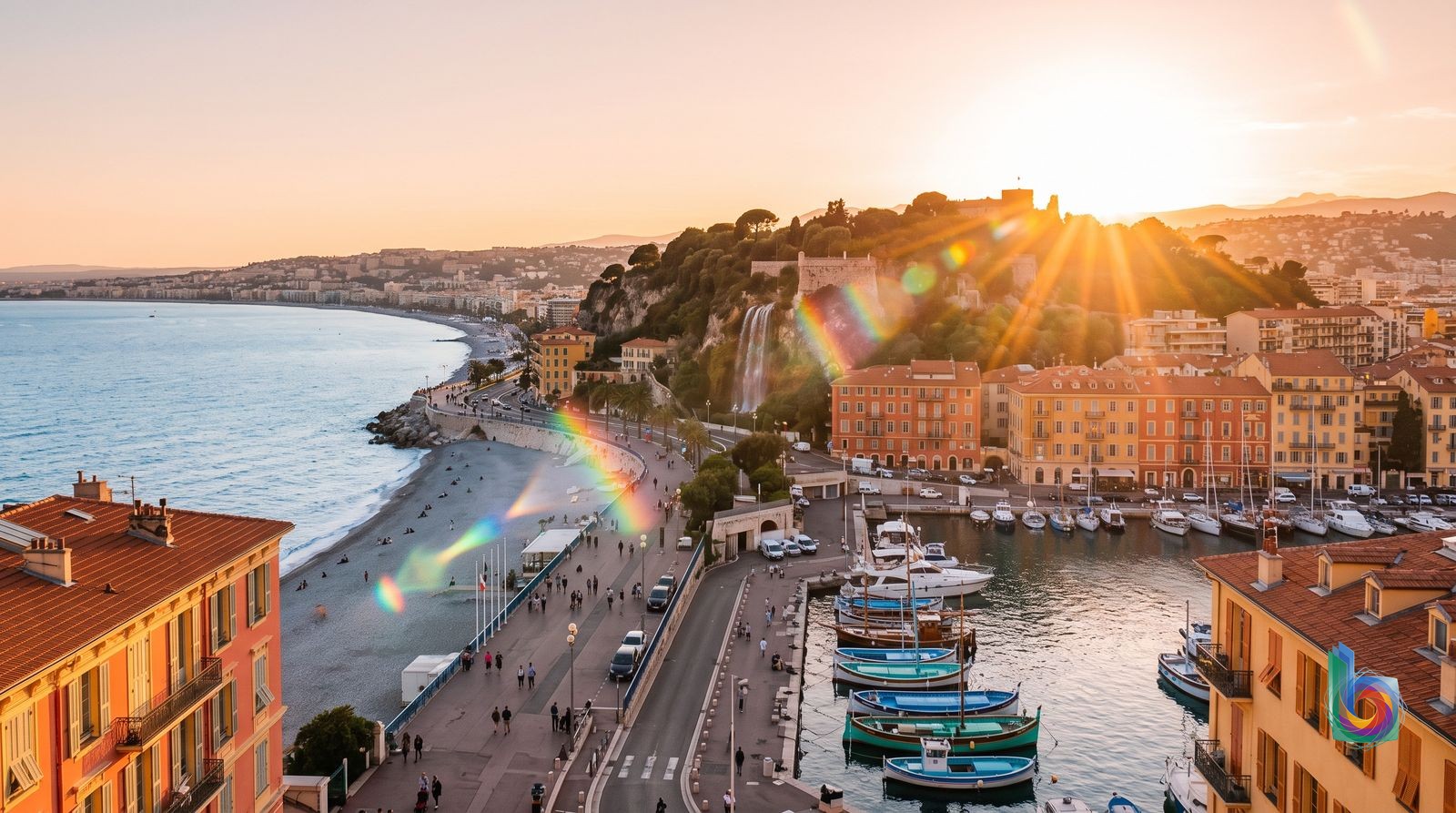
Season by season
November–March
Mild by northern-European standards but variable: expect cooler days, occasional rain, shorter daylight and a sea that is generally not for casual swimming. Some attractions run reduced seasonal hours or close on particular days.
This is not reliable beach weather, and winter schedules require checking ahead. February is an exception to the quiet-season pattern because Carnival fills the centre and raises accommodation demand.
April
A transition month: spring is arriving, but Nice can still feel surprisingly cool or wintry, particularly early in the month. Walking is pleasant on good days; swimming is more for the hardy.
Weather is less dependable than later spring, and it is too early to count on proper beach conditions.
May–June
One of the best windows: long, bright days, warming sea temperatures and generally comfortable conditions for walking, terraces and beach time without high-summer intensity.
It is no secret: demand builds quickly, especially around weekends and school holidays, though it is still usually less punishing than July and August.
July–August
Full Riviera summer: reliably hot, sunny and beach-oriented, with fierce midday sun. The city, waterfront, trains and popular streets are at their busiest.
Peak prices and crowds are the price of the weather. Nice’s public beaches are pebbled rather than sandy, and heat makes Old Town and Castle Hill walking tiring in the middle of the day.
September–October
The other prime window. September retains workable swimming weather; October is usually comfortable for urban exploring, with softer light and less oppressive heat than summer.
Weather becomes more changeable as October progresses, and the sea-and-sun guarantee weakens later in the period.
Events worth planning around
Nice Carnival · Usually February; the programme can extend into early March depending on the year.
Nice’s major winter disruption and draw. Parades and grandstands concentrate crowds in central Nice, affect street access and push up accommodation demand. Book lodging early if attending, and reserve parade/grandstand tickets as soon as dates are fixed.
Getting around
Walking
The compact sightseeing core: Vieux Nice, Place Masséna, the central Promenade des Anglais, Port Lympia and Castle Hill. Carré d’Or and the eastern end of the Promenade are also easy on foot; this is the best way to experience the old lanes and seafront.
Plan a walking loop rather than short rides: Vieux Nice–Cours Saleya–Colline du Château–port–Promenade works particularly well. Use the lift most of the way up Castle Hill if the climb is unwelcome. Wear shoes with grip for Old Town paving and bring water in summer.
Walking stops being effortless in Cimiez, Mont Boron/Cap de Nice and uphill parts of Fabron. Vieux Nice is cobbled, pedestrianized and awkward with wheeled luggage or strollers; summer heat and the Castle Hill climb make distances feel longer. Far-west Promenade hotels are not a casual walk from Old Town at night.
Tram
The default urban transport when walking is too far. Tram 1 is most useful for Nice-Ville/Jean-Médecin, Libération and Old Town-side stops; Tram 2 is the practical airport–centre axis and reaches the Port Lympia end of town.
Use Tram 1 for the Jean-Médecin/Thiers/Nice-Ville corridor, Libération and Garibaldi/Old Town access. Use Tram 2 from the airport or Arenas toward the centre and port side. Validate every ticket, and check current Lignes d’Azur ticket media and fares before travel.
There is no métro, and trams do not solve Nice’s hills: Cimiez, Mont Boron/Cap de Nice and many Fabron addresses still require a bus, a steep walk or a car ride. Tram coverage is also less convenient deeper into Riquier, and late-night frequency is less dependable than simply staying central and walking.
Bus
Filling the gaps beyond tram lines: Cimiez’s museums and residential hill, Mont Boron/Cap de Nice, and addresses in Fabron or along the Promenade that are not near a convenient tram stop. Bus 12 is a direct, slower option between the airport side and Vieux Nice via the Promenade.
Treat buses as a practical hill-and-gap tool, not the backbone of a short central stay. Check the live route and timetable on the day, especially if staying west of Gambetta, in Cimiez or on Cap de Nice. Validate your ticket.
Buses are vulnerable to traffic and crowding, particularly along the coast and in peak season. They become a poor fallback late at night, and they make Cimiez, Mont Boron and deeper Fabron feel more disconnected than their map distance suggests.
TER regional train
Fast, comfortable day trips along the Riviera: Monaco, Menton, Villefranche-sur-Mer, Antibes and Cannes. It is generally the better choice than coast buses when time matters.
Start at Nice-Ville for the widest range of central departures; Nice-Saint-Augustin is useful for airport connections and coastal services, while Riquier can help for some east-side journeys. Buy the appropriate SNCF/TER ticket and allow time at busy periods.
The train is for the coast, not getting around Nice itself. Nice-Ville is not near the beach or Old Town, while Riquier is not the main station for every journey. Services can be crowded in summer, and late-evening options are less flexible than central-city trams or a ride hail.
Uber/Bolt and licensed taxi
Late arrivals, luggage, steep or awkward addresses in Cimiez, Mont Boron/Cap de Nice and uphill Fabron, or getting home after transit becomes thin. Ride hailing is usually the sensible alternative to waiting for a taxi.
Use Uber or Bolt when practical and confirm the pickup point rather than blocking a tram or busy boulevard. Use only licensed taxis if taking a cab; from the airport, a ride hail to the centre is roughly €20 in the stored guidance, though fares vary.
Ordinary taxis are poor value for routine city travel, and road traffic can erase their advantage around the Promenade, Nice-Ville and central boulevards. Never take an unlicensed taxi.
Rental car
Not for a Nice city stay. Consider one only for a deliberate trip beyond the rail-friendly Riviera, with accommodation that includes workable parking.
For most visitors, combine walking, tram and TER instead. If you do drive, arrange parking before arrival rather than expecting to find easy street parking near Vieux Nice, Carré d’Or, the Port or the Promenade.
Parking, congestion and one-way streets make a car more burden than freedom in central Nice. It is especially unrewarding around Vieux Nice and the central beachfront, and it does not remove the inconvenience of narrow, steep residential streets in Cimiez or Mont Boron.
Safety: Pickpocketing is the main everyday risk around Nice-Ville, trams and tourist crowds: keep your phone and wallet zipped away, avoid Ariane, Pasteur and La Trinité after dark, and use normal care on quieter streets near the station and airport.
Book before you land
Nice Carnival grandstand/parade tickets, if visiting during Carnival: reserve as soon as dates are fixed; this is the city’s clearest timed-event bottleneck. · No major Nice museum is established in the supplied evidence as a routine weeks-ahead sell-out. Musée Marc Chagall, Musée Matisse and the city museums are better booked online for a preferred summer slot if offered, but do not build the trip around advance tickets; verify current hours and closures, especially Tuesday closures, before going.
- Nice is French with a real Niçois/Nissart and formerly Savoyard-Italian identity; a bonjour before a request and even modest French go much further than assuming English.
- Public beaches are free, but they are large pebbles, not sand. Bring water shoes or sandals and something padded to sit on; the seabed drops quickly and the pull can be strong, so this is not an ideal beginner-swimming beach.
- Pickpocketing is a real Riviera nuisance, especially around Nice-Ville/Thiers, tram stops, buses and tourist crowds. Keep phone and wallet zipped away rather than in trouser pockets, and be alert immediately after arriving by train.
- Avoid wandering at night in Ariane, Pasteur and La Trinité; use normal city caution on the less appealing streets just south of Nice-Ville and near the airport. Visible police and military patrols are normal here.
- Card payment is common, but keep a contactless bank card and a little cash for transit contingencies and small purchases. Check current Lignes d’Azur fares and ticket media: the evidence notes an older fare system and says some transport guidance is outdated.
- For a zero-cost first afternoon, walk Cours Saleya and Vieux Nice, climb—or take the lift most of the way up—Colline du Château for the Baie des Anges and port views, then return along the Promenade. It is the best free orientation loop; the hill park closes around sunset.
Worth leaving the city for
Villefranche-sur-MerHalf day; roughly 3–5 hours door to door from central Nice.
Go for the compact harbour town and a beach that is markedly kinder than Nice’s pebbly, fast-dropping shore—especially with children. It is close enough to treat as an escape hatch, not an expedition: two stops east by TER, or the scenic coastal bus. Do not spend a whole day here unless beach time is the point.
Èze VillageHalf day; allow 4–5 hours door to door, longer if you walk the Nietzsche Path down to Èze-sur-Mer.
This is the Riviera’s essential vertical change of scene: a genuinely dramatic medieval village above the sea, with the cactus garden’s wide-open view. It beats another afternoon shopping in Vieux Nice. Take a bus to Èze Village, not Èze Gare—the latter leaves a punishing steep climb. Expect crowds and perfume-factory shepherding; go early or late.
Saint-Jean-Cap-Ferrat and Villa Ephrussi de RothschildMost of a day; about 5–7 hours door to door from Nice, including a bus ride and the walk.
For the Riviera fantasy Nice cannot supply: a coastal footpath around an extravagant peninsula, swim stops, and Villa Ephrussi’s gardens. The cape walk is the real reason to come; the villa is an excellent add-on, not a substitute for it. This is better than Nice when the weather is good and you want landscape rather than urban sightseeing.
MentonFull day; roughly 7–9 hours door to door, with about 45 minutes each way by train from Nice-Ville.
Menton has a warmer, more Italian character than Nice, with pastel old-town lanes climbing above the sea and a proper border-town change of atmosphere. It is the best eastbound full-day choice for travelers who have already had their fill of Riviera glamour. The coastal TER makes it straightforward; avoid treating it as a rushed Monaco add-on.
AntibesFull day; roughly 7–9 hours door to door, with around 30 minutes each way by TER.
Antibes earns the westbound trip for its old walled town, harbour and a more legible, lived-in historic core than Cannes. It is a better use of a day than Cannes for most first-time visitors unless you specifically want the Croisette, luxury hotels and film-festival mythology. Beaches are better nearby than in central Nice, though summer crowds are real.
Monaco and Monte-CarloHalf day to a compact full day; allow 4–7 hours door to door, with frequent trains from Nice taking roughly 20–25 minutes.
Go once because nowhere else on this coast is so bizarrely concentrated: cliffside density, yacht harbour, palace-state spectacle and casino-era grandeur. It is not charming, cheap or relaxed, and that is precisely the point. Combine it with Èze only if you are happy with a long, transit-heavy day; otherwise give Monaco a focused half day.