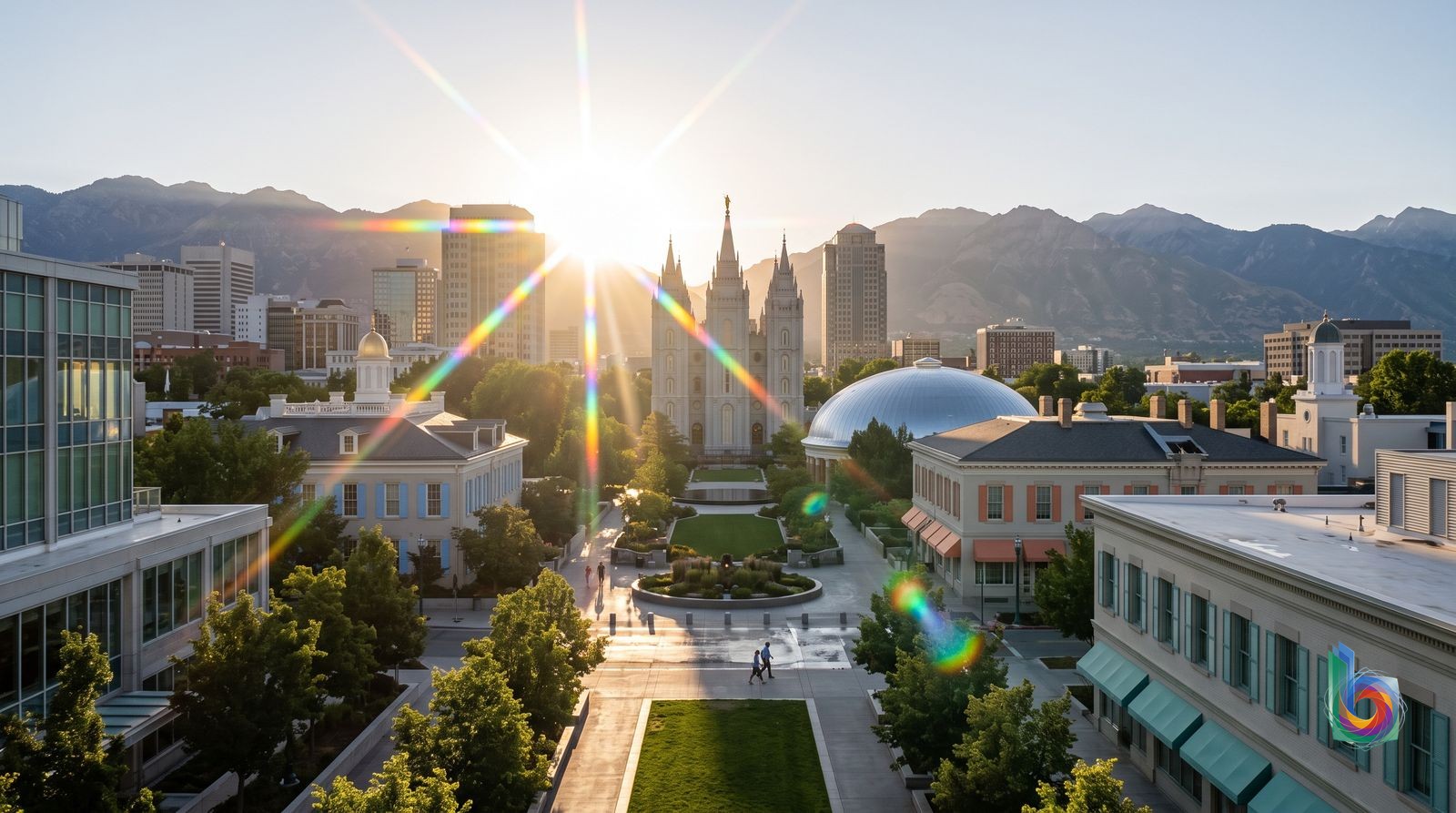
First visit? Stay in Downtown & Temple Square.
It is the least complicated first base: Temple Square, City Creek, the Salt Palace and much of the central sightseeing are on foot, while TRAX gives direct airport access and Red Line access toward the University. It has the city’s deepest hotel selection, from major luxury properties to practical value rooms. The trade-off is a corporate, sometimes quiet evening atmosphere and too much mall, chain and hotel dining; stay here for convenience, then go out to Sugar House, 9th & 9th or Central Ninth for more local character.
luxury →
This is where Salt Lake’s established full-service luxury hotels cluster, including the Grand America, along with the city’s easiest access to landmark sightseeing, convention facilities and airport TRAX. It is more polished and convenient than The Avenues, whose boutique appeal comes with hills and fewer nearby services.
value →
Practical hotels, direct Green Line airport access and easy connections into downtown make this a sensible money-conscious base, particularly for short stays or arena trips. Check the precise block: it is less charming than Downtown & Temple Square, and event nights can bring both noise and higher demand.
family →
Sugar House Park, casual food, shops and a lived-in residential atmosphere make this easier for families than a downtown hotel corridor. Choose it over University & Fort Douglas unless campus museums or a University event are central to the trip; it is better for everyday meals and park time, but requires transit, rideshare or a car for downtown sights.
nightlife →
For newer restaurants, bars, breweries and a more energetic evening scene, this is Salt Lake’s strongest base from the list. Central Ninth’s TRAX station keeps downtown close. Book carefully: the surrounding redevelopment landscape is uneven, some blocks empty out late, and venue-adjacent rooms can be noisy.
quiet →
Historic homes, leafy residential streets and a removed-from-downtown feel suit travelers who want calm rather than an entertainment district. Pick it over Capitol Hill & Marmalade for more sustained neighborhood wandering; accept that the uphill return, limited dining and winter ice make it a poor choice for mobility concerns.
rail-day-trips →
Downtown puts visitors closest to the most useful TRAX connections: Green Line service to the airport and Red Line service toward the University, with the central sights walkable between rides. Gateway also works for the airport line, but Downtown & Temple Square is the stronger all-purpose base once off the train.
return-visitor →
This is the better choice once Temple Square is no longer the whole itinerary: compact local cafés and restaurants, bungalow streets and Liberty Park give it real daily-life texture. It is quieter and more intimate than Sugar House, but lodging is limited and transit to downtown is bus-based rather than direct TRAX.
Avoid sleeping near Pioneer Park and the immediately surrounding west-of-downtown blocks: Do not reject all of west downtown—Gateway can be practical—but this is a weak leisure base. The area is near a busy homeless shelter and has a documented concentration of drug activity; it can feel uncomfortable after dark and offers little compensating neighborhood appeal for most visitors.
Avoid sleeping near Glendale & the west side: Worth a planned visit for International Peace Gardens and international food, but tourists often regret sleeping here if they expect easy sightseeing, airport rail or strollable evening options. It is spread out, bus-dependent and materially easier with a car; use normal extra property-crime awareness after dark.
Avoid sleeping near Far East Bench & Foothill addresses: These listings can look close to downtown on a map but are usually car-dependent, hilly and dispersed. They work for canyon drives, hospital or University business, not for a short car-free city break; downtown is not a realistic walk from most of the district.
Avoid sleeping near The Granary’s isolated warehouse-edge blocks: Central Ninth can be a good nightlife base, but not every nearby industrial conversion is equally convenient. Construction, vacant parcels and deserted late-night stretches mean an inexpensive listing can leave you far from the actual restaurants, bars and TRAX station.
The neighborhoods
Pick the areas you want to be around — the hotels and tables below narrow to them.
Stay here Fine base Visit, don't sleep
Downtown & Temple SquareFirst-timer default
Sights, hotels, transit, corporate calm
This is the practical center: Temple Square, City Creek, museums, the Salt Palace, major hotels and a surprisingly compact core on Salt Lake’s easy-to-read grid. It is polished and convenient rather than continuously lively; office-worker energy drops sharply outside event hours.
Vs. others: Pick Downtown & Temple Square over Sugar House if you want Temple Square, museums, the airport train and walkable hotel choice; pick Sugar House if local restaurants and a lived-in neighborhood matter more than sightseeing convenience.
The city’s best-connected base: TRAX runs through or immediately beside downtown, including the Green Line to the airport and Red Line service toward the University. Temple Square, City Creek, the Salt Palace and much of central sightseeing are walkable, though the blocks are unusually wide.
Best for: first-timers, families, rail-day-trips, luxury, value
The central core can feel empty after business hours and on quieter weekends. · Restaurant choice near the main sights leans chain, hotel and mall dining. · Pioneer Park and some west-of-downtown blocks merit more street awareness after dark, especially around the shelter area.
See hotels in Downtown & Temple SquareSugar HouseExcellent base
Local shops, parks, and neighborhood dining
Salt Lake’s most consistently useful neighborhood outside downtown: a commercial center around 2100 South with independent-minded shops, coffee, bars and restaurants, plus Sugar House Park nearby. It feels residential and lived-in, not like a historic tourist quarter, and lodging is more scattered than downtown.
Vs. others: Pick Sugar House over Downtown & Temple Square if you want neighborhood eating and park access; pick Downtown if you want to walk to the marquee sights and have simpler airport and regional-rail connections.
The S-Line streetcar links Sugar House with Central Pointe, where TRAX connections are available; buses fill in the network. It is pleasant for local wandering, but Temple Square is not a casual walk and a car or rideshare makes evenings easier.
Best for: foodies, return-visitors, families, quiet, travelers with cars
It is not a direct walk to downtown attractions. · The commercial center can be traffic-heavy and parking-focused. · Hotel inventory is thinner than downtown, so a seemingly nearby rental may still be a long walk from the useful strip.
See hotels in Sugar HouseThe AvenuesExcellent base
Historic houses above the city
A handsome, hilly residential grid of Victorian-era and early-20th-century homes northeast of downtown. It is appealing for architecture, porch-lined walks and a quieter local rhythm; it is not an all-day shopping district. Small inns, B&B-style stays and rentals make more sense here than a conventional hotel cluster.
Vs. others: Pick The Avenues over Capitol Hill if you want a broader residential area with more everyday neighborhood texture; pick Capitol Hill if capitol views and a shorter downhill walk to downtown are the priority.
Bus service connects the neighborhood with downtown and the University, but the steep grades are real. Walking downhill into downtown is feasible for many visitors; returning uphill, especially after dinner, is less appealing.
Best for: quiet, couples, return-visitors, architecture fans
Hills make this a poor fit for mobility-limited travelers and can be tiring at altitude. · Dining and nightlife are limited compared with Downtown or Sugar House. · Winter snow and ice make its slopes and residential streets more awkward.
See hotels in The AvenuesCapitol Hill & MarmaladeAcceptable base
Capitol views and eclectic uphill streets
North of downtown, Capitol Hill is the grander, affluent slope below the Utah State Capitol; Marmalade, just west of it, is smaller, quirkier and more mixed. Together they make a characterful short-stay alternative with skyline views, historic homes and the occasional boutique or inn, but not a complete visitor district.
Vs. others: Pick Capitol Hill & Marmalade over The Avenues if you want to be closer to downtown and the Capitol; pick The Avenues if you want a fuller residential neighborhood and more attractive street wandering.
The Capitol is a manageable walk from downtown only if you are comfortable with a climb; buses serve the area, but it is not as plug-and-play as a downtown TRAX hotel. Temple Square lies downhill and south.
Best for: quiet, couples, return-visitors, architecture fans
The uphill return from downtown is the defining practical drawback. · Services are sparse, particularly late at night. · Marmalade’s block-by-block character is uneven, so do not assume every listing has the same polished feel as Capitol Hill.
See hotels in Capitol Hill & MarmaladeUniversity & Fort DouglasAcceptable base
Campus, museums, foothill access
The University of Utah campus and historic Fort Douglas sit east of downtown on the bench. It is useful for campus events, the Natural History Museum of Utah, Red Butte Garden, hospital visits and foothill access; otherwise it feels institutional and spread out rather than like a visitor neighborhood.
Vs. others: Pick University & Fort Douglas over The Avenues if campus museums, Red Butte Garden or a University event anchor your trip; pick The Avenues if you want historic streets and easier access to downtown dining.
The Red Line runs from downtown to the University, making campus access straightforward. Within the large campus and up to hilltop attractions, however, distances and grades add up; downtown is not an attractive walk for most visitors.
Best for: families, quiet, museum visitors, rail-day-trips, University of Utah events
The campus is expansive, with long walks between attractions. · Food options skew campus-oriented and can be limited outside academic rhythms. · It is uphill from downtown and can feel quiet at night.
See hotels in University & Fort Douglas9th & 9th and Liberty WellsExcellent base
Cafés, bungalows, everyday Salt Lake
Around 900 South and 900 East, this is one of the city’s best small-scale wander zones: bungalow streets, local cafés, casual restaurants and shops, with Liberty Park close by. It has genuine neighborhood life and little tourist packaging, though the visitor sights are not on the doorstep.
Vs. others: Pick 9th & 9th and Liberty Wells over Sugar House if you want to be a little closer to downtown and prefer compact café-and-bungalow streets; pick Sugar House if you want a bigger commercial district and park.
Buses connect this area to downtown; it is bikeable and roughly a longer walk from the core rather than an effortless sightseeing base. There is no direct TRAX station in the heart of 9th & 9th.
Best for: foodies, quiet, return-visitors, couples, families
Lodging is mostly rentals and small properties rather than a broad hotel market. · Transit is less convenient than Downtown or the University. · The retail strip is charming but short; travelers expecting an all-day district may exhaust it quickly.
See hotels in 9th & 9th and Liberty WellsCentral Ninth & Granary DistrictAcceptable base
Breweries, studios, warehouses, change
South and southwest of downtown, Central Ninth has become a useful pocket for coffee, restaurants and bars, while the Granary District is a redevelopment zone of warehouses, makers and newer venues. This is where to look for Salt Lake’s emerging creative energy, not for postcard history or a fully finished neighborhood.
Vs. others: Pick Central Ninth & Granary over Downtown & Temple Square if bars, newer restaurants and an industrial edge matter more than landmark proximity; pick Downtown if you want a more polished, easier first visit.
Central Ninth has a TRAX station and is close to downtown by train, bike or a longer walk. The Granary’s individual venues can be spread out, and the most useful stop depends on the exact address.
Best for: nightlife, foodies, return-visitors, younger travelers
Construction, vacant parcels and abrupt transitions are part of the landscape. · Some streets are uncomfortable-feeling or simply deserted late at night. · Noise and nightlife can be a problem in apartment-style stays near active venues.
See hotels in Central Ninth & Granary DistrictGateway & west DowntownAcceptable base
Arena events, mall, airport-ready hotels
The Gateway area is an entertainment-and-shopping cluster west of the central business core, useful for arena events, family attractions and some practical hotels. It is more of a destination complex and transit junction than a coherent historic neighborhood, with blocks that can feel very different from one another.
Vs. others: Pick Gateway & west Downtown over Downtown & Temple Square if an arena event, the airport line or family entertainment is your priority; pick Downtown & Temple Square if Temple Square and the city’s core sights are the reason you came.
The Green Line provides direct airport access and downtown TRAX connections; the central core is walkable from Gateway. Its broad roads and freeway-adjacent edges make some walks feel less pleasant than the map suggests.
Best for: families, event-goers, rail-day-trips, value, airport overnights
Retail-center atmosphere can feel generic. · The area gets loud and congested around events, then quiet after them. · Nearby west-side blocks require more nighttime judgment than the polished mall zone itself.
See hotels in Gateway & west DowntownEast Bench & FoothillAcceptable base
Mountain-side calm, car-friendly base
This broad residential bench east of the core is about foothill views, larger homes, medical and university access, and quicker positioning for canyon drives. It is comfortable and generally calm, but it is not a walkable visitor district; choose it deliberately, not because a map makes it look close to downtown.
Vs. others: Pick East Bench & Foothill over Sugar House if canyon access, space and a quiet residential setting outweigh restaurants within walking distance; pick Sugar House if you want to wander to meals and shops.
Foothill Boulevard is served by buses, but the district’s scale, hills and dispersed destinations favor a car. Downtown and Temple Square are not realistically walkable from most addresses.
Best for: quiet, families, travelers with cars, outdoor-focused visitors
A car is close to essential for a convenient stay. · Commercial pockets are scattered rather than forming a walkable center. · Winter driving and valley inversion pollution can undercut the mountain-adjacent appeal.
See hotels in East Bench & FoothillGlendale & the west sideVisit, don't sleep
International food and local city life
Southwest of downtown, Glendale is a heavily Hispanic, residential part of the city with the International Peace Gardens and food that reflects communities often missed by downtown visitors. It offers a more everyday, diverse Salt Lake than the east-side visitor districts, but it is not set up as a conventional tourist base.
Vs. others: Pick Glendale & the west side over Sugar House if you want international food and a less curated local perspective; pick Sugar House if you need walkable lodging, shops and an easy evening out.
Buses serve the area, but distances are larger and connections less effortless than downtown TRAX corridors. The International Peace Gardens are best approached with a car, bike or a planned bus trip rather than folded into a central walking day.
Best for: foodies, return-visitors, budget-minded travelers, travelers seeking local culture
It is not well positioned for the main sights or airport rail connection. · Property crime concerns are greater in lower-lying parts of the city; use normal urban caution, especially after dark. · Amenities and sidewalks can be uneven, and a car materially improves the experience.
See hotels in Glendale & the west sideWhere to stay
Hotels in Salt Lake City
The Grand America HotelHotel · $$$4.7 · 9,154 reviews
Placemakr Salt Lake City Downtown, Apartments by HiltonHotel4.8 · 118 reviews
The Little America Hotel - Salt Lake CityHotel · $$4.4 · 9,208 reviews
Kimpton Hotel Monaco Salt Lake CityHotel · $$$4.4 · 1,967 reviews
Hyatt Regency Salt Lake CityHotel4.5 · 1,103 reviews
Salt Lake City Marriott City CenterHotel · $$4.4 · 1,655 reviews