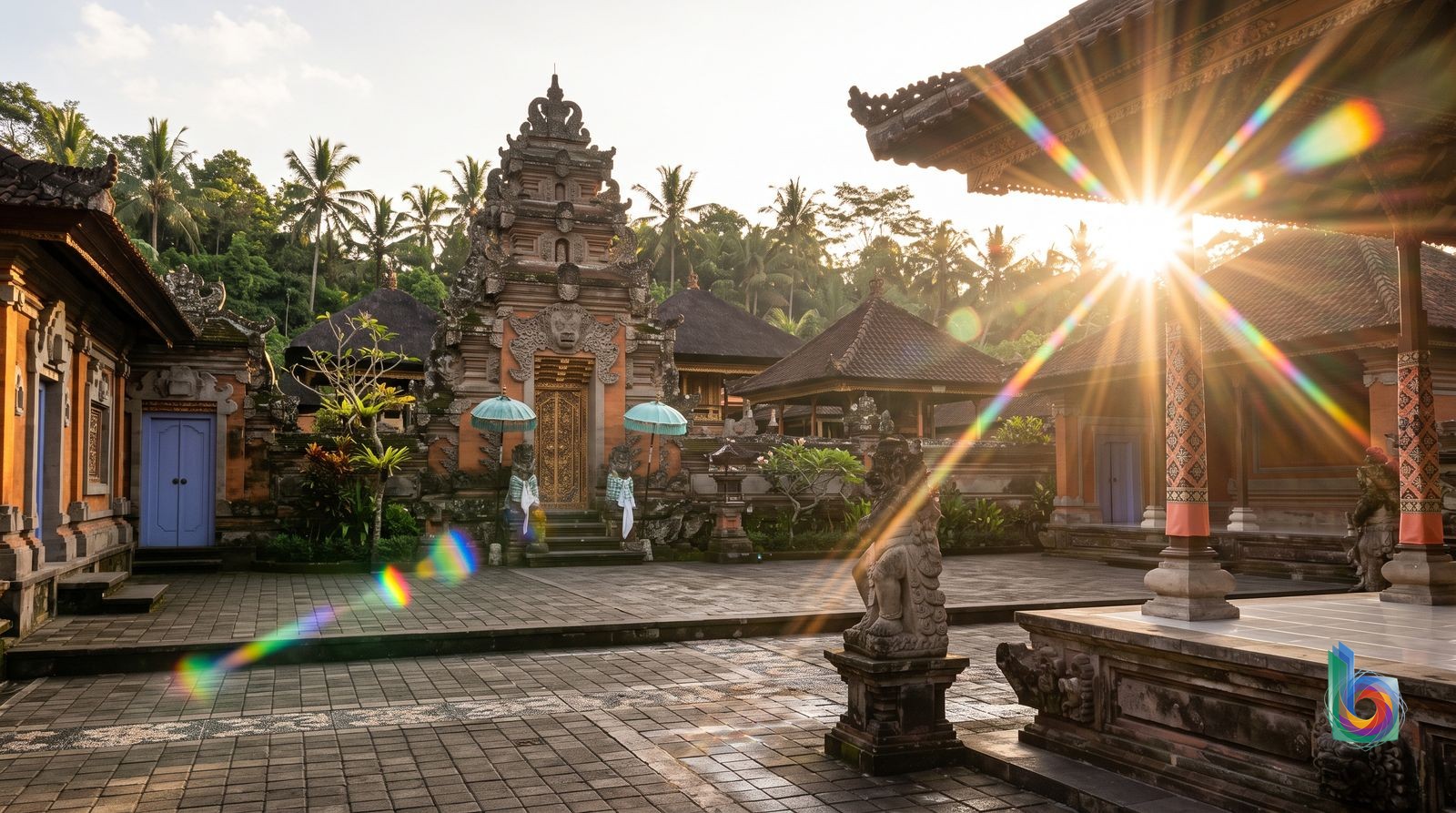
Season by season
December–March
Wet season: frequent heavy rain, high humidity and occasional washed-out afternoons. The rice fields and jungle are at their lushest, but paths can be slippery.
Rain can disrupt walks, temple visits and day trips; Christmas/New Year is an expensive, busy exception with stronger demand for rooms, drivers and performances.
April
A transition month as the wet season eases. Expect greener scenery and a mix of dry spells and showers.
Weather is less dependable than the dry-season months; retain a rain-plan for outdoor sightseeing.
May–June
The strongest overall balance: relatively dry weather while the landscape remains green, before the busiest school-holiday period.
It is already popular, so book sought-after drivers, classes and evening performances a few days ahead rather than assuming everything will be available.
July–August
Dry-season weather and generally good sightseeing conditions, but this is Ubud’s high season.
Peak accommodation prices, fuller restaurants and performances, heavier traffic, and substantially more crowded central Ubud. Reserve capacity-limited tours and any specific dance night several days ahead.
September
Still relatively dry, green and generally less intense than the July–August peak.
It remains a popular month, and traffic around the centre and major out-of-town sights is still a real constraint.
October–November
Shoulder season, with humidity and rain increasing as the wet season returns. The countryside stays vivid and green.
Showers become increasingly likely and can interrupt an afternoon; roads and walking surfaces can be less pleasant after rain.
Events worth planning around
Nyepi (Balinese Day of Silence) · Usually March; the date changes annually under the Balinese calendar.
This is Bali-wide rather than an Ubud spectacle: normal movement and activity stop for the Day of Silence, and Ngurah Rai airport closes. Plan arrivals/departures around it, respect the restrictions, and expect the preceding Melasti and ogoh-ogoh period to affect roads and local routines.
Galungan and Kuningan · Twice yearly on the 210-day Balinese pawukon cycle; dates vary annually, with Kuningan falling 10 days after Galungan.
A rewarding time to see Ubud’s temple life and decorated penjors, but ceremonies are worship, not performances. Temple access, opening routines and staff availability can change; dress appropriately and do not build a tight sightseeing schedule around a specific temple visit.
Christmas and New Year · Late December to early January.
This is a peak-demand period despite wet-season weather. Accommodation, private drivers, popular restaurants and selected evening performances should be reserved earlier, and traffic is likely to be worse.
Getting around
Walking
Central Ubud only: the Palace/Market, Goutama, Jembawan, Jl Monkey Forest, Hanoman, Dewi Sita and nearby lanes. It is the best way to experience the core and avoid sitting in the Palace–Market traffic knot.
Walk early or after the worst heat. Treat crossings defensively and use your phone map as a locator, not proof of a safe footpath; sidewalks often disappear into parked motorbikes or broken paving.
It stops being pleasant or practical outside the compact core. Campuhan has hills and uneven paths; Bisma and Kajeng have indirect lanes; Penestanan involves ravine crossings and dark returns; deeper Peliatan, Nyuh Kuning/Pengosekan, Teges and Bedulu are too hot, traffic-heavy or far for a casual central-Ubud walk. Avoid roadside walking after dark, especially toward Goa Gajah.
Grab or Gojek ride-hailing
Short point-to-point trips when you are outside the walkable center: Peliatan, Pengosekan, Nyuh Kuning, Penestanan and out-of-town sights such as Goa Gajah. Also useful for avoiding a tiring walk back to a hotel in the rain or heat.
Order through the app and pin a recognizable pickup point rather than an obscure villa lane. Keep some cash as a backup, and message or call if the driver cannot find the entrance.
Pickups can be awkward or actively resisted in some villages and tourist areas, and narrow lanes in Bisma, Kajeng, Penestanan, Nyuh Kuning and resort valleys may be inaccessible. Do not count on app cars as a seamless late-night solution; traffic makes even short central trips slow.
Hired local car and driver
The sensible default for a half- or full-day circuit: Goa Gajah, Tegallalang, Tirta Empul, and any itinerary beyond town. It is also the most reliable choice from Sayan, Kedewatan and the farther reaches of Peliatan or Bedulu.
Arrange through your hotel, a reputable local driver, or a pre-booked service. Agree the route, waiting time and total fare before departure—Ubud has no base of metered taxis. Ask for pickup at a main road if your villa sits down a narrow lane.
A car is a bad tool for central Ubud: parking, one-way squeezes and the Jl Raya–Monkey Forest junction can turn a short journey into a crawl. Sayan and Kedewatan’s steep valley roads, plus Penestanan and Bisma’s narrow access lanes, can require a walk to the vehicle. Build a day around one major out-of-town sight, not an unrealistic six-stop loop.
Scooter or motorbike rental
Experienced, properly licensed riders staying beyond the core—especially Penestanan, Peliatan, Nyuh Kuning/Pengosekan, Sayan or Bedulu—who want independence for short local trips and accept Bali road conditions.
Rent only with the correct licence and appropriate insurance, wear a helmet, and inspect the bike before leaving. Use it to link dispersed districts and sights, not to force your way through the Palace/Market center.
This is not a beginner destination. Ubud combines steep valley roads, patchy surfaces, weak pedestrian infrastructure, dense mixed traffic and rain-slick roads in the wet season. Central Ubud is congested and stressful on two wheels; skip the scooter entirely if you are not confident riding in this environment.
Local bemo/minibus
An occasional daytime option for travelers who are flexible, traveling light and happy to ask locally rather than follow a fixed timetable. Traditional bemo activity is closest to the central market area.
Ask your accommodation where and whether a service is currently running for your intended direction, and confirm the destination before boarding. Regard it as an experience or backup, not a timed transfer.
There is no dependable visitor network: services are limited, routes are thin, and they largely fade by late afternoon. They are not practical for Sayan, Kedewatan, deeper Penestanan, the Goa Gajah/Bedulu side, or a return after an evening performance. There is no metro or rail in Ubud.
Safety: In Ubud, walk defensively on patchy, traffic-heavy roads—especially after dark—and at Monkey Forest keep food and valuables zipped away, never touch macaques, and seek medical advice immediately for any bite or scratch.
Book before you land
None of Ubud’s principal fixed sights—Goa Gajah, Gunung Kawi, Tirta Empul, Ubud Palace or the walks—normally require advance tickets; buy entry on site rather than paying a reseller. · Book a specific evening dance or shadow-puppet performance at Ubud Palace or a desired venue 1–3 days ahead in July–August, over Christmas/New Year, or if you want a particular night. Otherwise, do not overbook Ubud. · If Mount Batur sunrise trekking, rafting, a cooking class, or a private driver itinerary is non-negotiable, reserve several days ahead in peak season. These are capacity-limited services, not scarce Ubud admission tickets.
- Carry cash in small rupiah notes for drivers, stalls, offerings and smaller cafés, but use bank-connected exchange offices only. Avoid the too-good-to-be-true independent money changers: recounting tricks are a known Bali scam.
- Dress temple-appropriately—covered shoulders and a sarong/sash where required—and follow restrictions without argument. At Tirta Empul, do not enter the purification pools if you are not appropriately dressed or during religious restrictions; it is an active holy site, not a themed bath.
- Monkey Forest macaques steal glasses, phones, jewellery and bags and can bite. Carry no food, do not feed or touch them, keep belongings zipped away, and seek medical advice immediately after any bite or scratch because rabies is a Bali concern.
- A polite but firm 'tidak, terima kasih' (no, thank you) is useful with persistent ride and tour sellers. Avoid prolonged negotiation if you do not want the service; agreed local-car fares should be settled before departure.
- Do not assume a Google Maps walking route is pedestrian-safe. Sidewalks can vanish into motorcycle parking or broken paving; walk defensively, especially after dark and on the approaches to Goa Gajah or other out-of-centre sights.
- Build in time rather than trying to tick off attractions. Ubud’s traffic and heat make one major out-of-town temple or historical site plus one central stop a realistic day, not a six-stop Instagram itinerary.
Worth leaving the city for
Tampaksiring–Tegallalang loop: Tirta Empul, Gunung Kawi and the rice terracesFull day — roughly 7–9 hours door to door with a car and driver; Gunung Kawi alone is about 18 km northeast of Ubud and traffic makes timings unreliable.
This is the essential north-of-Ubud day: Tirta Empul is a living purification temple, Gunung Kawi has the real archaeological drama (and 371 steps), and Tegallalang supplies the sculpted-rice-field landscape. It beats another day in central Ubud because these are the places that explain why Ubud’s cultural orbit matters. Start at Gunung Kawi, before the heat and tour groups; do not treat a rushed ‘waterfall/coffee/swing’ package as a substitute. Tegallalang is photogenic but heavily commercialised, so keep expectations in check.
Jatiluwih rice terraces and Pura Luhur BatukaruFull day — allow 8–10 hours door to door. The Tabanan/Batukaru–Jatiluwih area is about an hour north by car in clear conditions, longer with traffic.
If rice landscapes are the point, Jatiluwih is the better use of a day than the crowded, swing-filled edges of Tegallalang. Pair it with the quiet, forested Batukaru Temple for a genuinely rural central-Bali outing rather than an Ubud attraction conveyor belt. The downside is that it is a driving day, not a casual hop, and rain or low cloud can flatten the views.
Bedugul: Ulun Danu Bratan, Bali Botanic Garden and Candikuning marketFull day — around 7–9 hours door to door. The evidence puts Bedugul at about one hour north by car, but that is not a guarantee in Bali traffic.
Bedugul earns the escape because its cool highland air, lake setting and botanical garden are a decisive change from Ubud’s humid, clogged centre. Ulun Danu Bratan is famous for good reason, but go early: it is a major photo stop, not an undiscovered temple. Candikuning’s fruit market is a useful stop, not a destination in itself.
Sidemen ValleyFull day — realistically 8–10 hours door to door, including roughly 1.5–2 hours each way depending on where in the valley you go and traffic.
Choose Sidemen if what you wanted from Ubud was quiet village Bali: working rice fields, valley roads and Mount Agung views on a clear day. It beats a further day in central Ubud precisely because it has far less of Ubud’s café-and-traffic overload. It is not a box-ticking sight; go for an unhurried walk, landscape and a long lunch. Cloud can erase the volcano, and the area is spread out, so it works best with a driver.