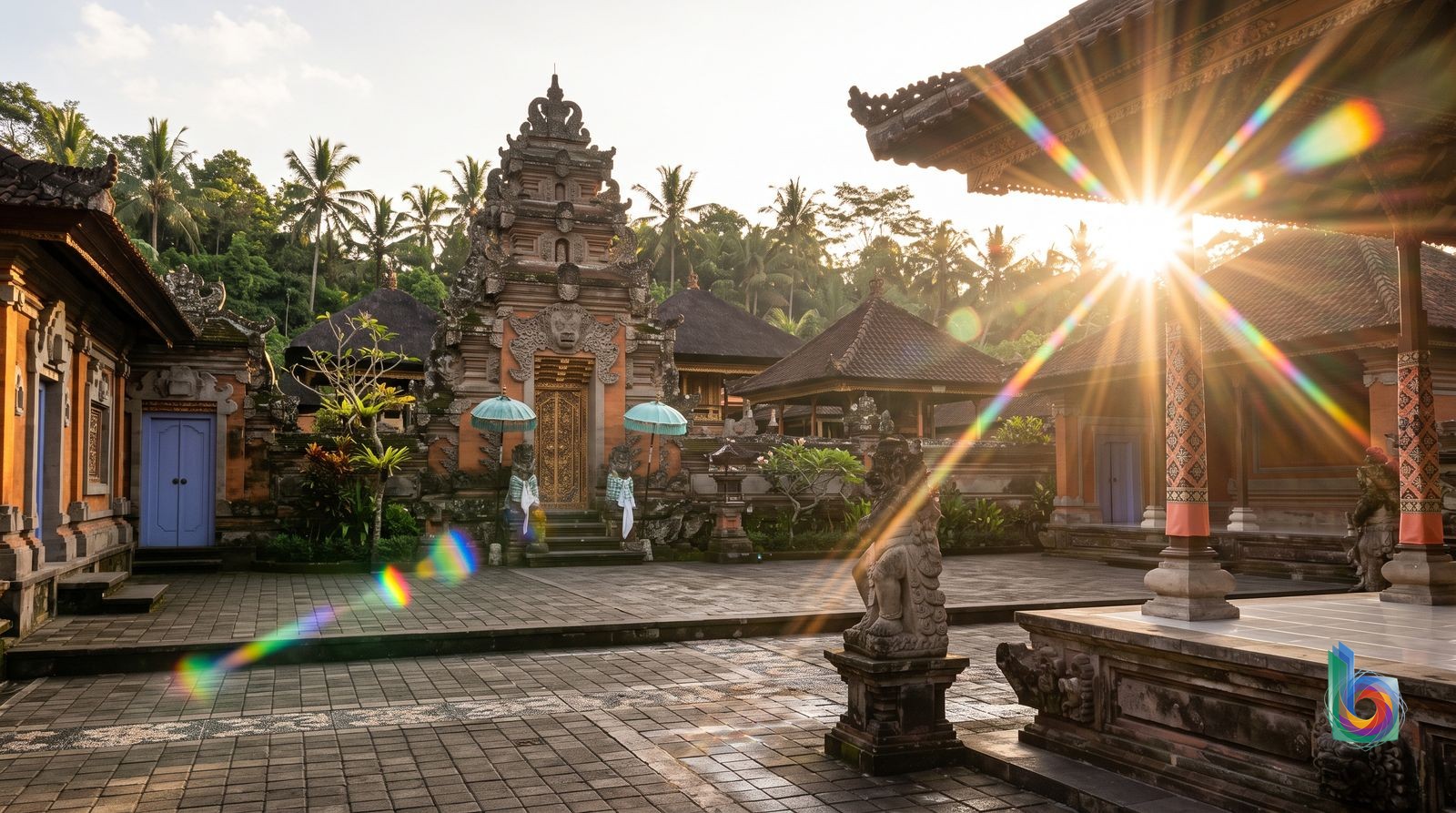
First visit? Stay in Central Ubud (Palace, Market, Goutama and Jembawan).
For a first Ubud stay, this is the least complicated base: you can walk to the Palace, market, many restaurants, cafés and evening options without relying on a scooter or driver. It is not tranquil—expect traffic, exhaust, crowded pavements and tourist-facing dining—but for a short first visit, convenience beats the illusion of a remote rice-field retreat. Choose a room down Goutama, Jembawan or a quieter lane rather than directly on the main crossroads.
luxury →
Choose Sayan when the hotel is a central part of the trip: Ayung-valley privacy, pools, villas and a genuinely removed atmosphere suit honeymooners and wellness-focused travelers. It is more practical than Kedewatan for combining resort time with central Ubud, but it requires hotel transfers or a driver.
value →
Kajeng is the sensible value compromise: family-compound homestays and small guesthouses, a quieter feel than the main roads, and a manageable walk to the Palace and market. It is better than Peliatan for travelers who do not want to arrange transport for every dinner.
family →
For families staying more than a couple of nights, this is calmer and more village-like than Monkey Forest Road while remaining near the forest and its services. Pick a property with a pool and confirm vehicle access; the central market is not an effortless walk from deeper addresses.
nightlife →
Ubud is not a major clubbing destination, but this is the best fit for sociable evenings: dense dining, bars, cafés and the easiest walk back from central activity. The trade-off is the town's most persistent traffic, tourist density and noise.
quiet →
Campuhan gives fit walkers river-valley scenery, the Ridge Walk and a more atmospheric edge of town without total isolation. It is quieter than Central Ubud, though hills, narrow roads and limited nearby evening dining make it a poor choice for anyone who wants frictionless walking after dark.
rail-day-trips →
There are no rail services in Ubud—or a useful rail-day-trip base in the usual sense. For driver-led Bali excursions, Central Ubud is the practical choice because it is the town's transport focal point, with local cars, hotel pickups and the traditional daytime bemo gathering point near the market. Do not rely on bemos late in the day.
return-visitor →
Penestanan suits travelers who already know they do not need to be beside the Palace: it has a more residential, creative, long-stay character and quieter nights than the core. It is a better second-visit choice than Central Ubud, provided you are comfortable with lanes, darker walks and occasional scooter or driver use.
Avoid sleeping near The Jl Raya Ubud–Jl Monkey Forest crossroads and rooms directly on its busiest main-road frontage: This is Ubud's traffic choke point: near-permanent jams, horns, exhaust, crowded sidewalks and transport hawkers. Stay nearby for walkability, but avoid sleeping directly on the loudest frontage unless a heavily discounted room and reliable soundproofing matter more than rest.
Avoid sleeping near Deep Teges and Bedulu (Goa Gajah side): These are worthwhile temple-side villages to visit, especially for Goa Gajah, but they are a transport-dependent sleeping base for most tourists. Central Ubud dinners, performances and everyday café options require a scooter or driver, and main-road walking is unattractive in heat and traffic.
Avoid sleeping near The most remote valley-resort addresses in Kedewatan: Kedewatan can be excellent for a deliberate luxury retreat, not for travelers expecting to wander Ubud each day. Slopes, stairs, isolated access roads and repeated hotel-car or driver trips make it easy to feel stranded after dark; choose Sayan instead if you want luxury with somewhat easier central access.
The neighborhoods
Pick the areas you want to be around — the hotels and tables below narrow to them.
Stay here Fine base Visit, don't sleep
Central Ubud (Palace, Market, Goutama and Jembawan)First-timer default
Walkable core, maximum Ubud friction
This is the practical heart of Ubud: the Palace and market, short lanes of cafés, shops, family compounds and a dense choice of small hotels. It is the easiest place to arrive without a scooter and wander on foot, but it is not the serene rice-field Ubud of the postcards; the main junction is routinely jammed and the center is built around tourism.
Vs. others: Pick Central Ubud over Penestanan if you want to walk to the Palace, market and a broad choice of meals; pick Penestanan if a quieter, more residential evening matters more than being central.
There is no metro or rail. This is Ubud's best walking base: the Palace/Market crossroads connects Jl Raya Ubud and Jl Monkey Forest, and local bemos traditionally gather here, though services are limited and thin out late afternoon. Expect to use a hired driver or ride-hailing/local car for places beyond the core.
Best for: first-timers, value, foodies, short-stay travelers, travelers without scooters
The Jl Raya–Monkey Forest intersection has near-constant congestion, noise and exhaust. · Sidewalks can be narrow, blocked or broken, so walking is less relaxing than the map suggests. · Restaurants nearest the market include plenty of tourist-oriented choices.
See hotels in Central Ubud (Palace, Market, Goutama and Jembawan)Monkey Forest Road and Padang TegalExcellent base
Lively south spine, forest at end
The southern run from central Ubud to the Sacred Monkey Forest is lined with accommodation, cafés, galleries and services, then blends into Padang Tegal just south of the forest. It is one of the most convenient places to stay if the forest and a busy evening scene are priorities, with options ranging from homestays down lanes to polished hotels.
Vs. others: Pick Monkey Forest Road over Hanoman if being closest to the Monkey Forest and the most obvious central action matters; pick Hanoman if you prefer a slightly more restaurant-led, east-side base.
Walkable north to the Palace and Market and south to Monkey Forest; Padang Tegal is roughly a 20-minute walk from the central market. There is no formal urban transit network, and traffic makes short car trips unreliable at busy times.
Best for: first-timers, nightlife, foodies, travelers who want walkability
This is among the busiest and most tourist-saturated stretches in town. · Traffic, motorbikes and persistent transport offers can make the walk unpleasant. · At Monkey Forest, secure glasses, cameras and food: monkeys steal items and can bite.
See hotels in Monkey Forest Road and Padang TegalHanoman and Dewi SitaExcellent base
Café-heavy central east side
Running parallel to Monkey Forest Road, Jl Hanoman and its connecting lanes are a dense, walkable mix of cafés, higher-end restaurants, boutiques, yoga-oriented businesses and guesthouses. It feels urban by Ubud standards: useful, sociable and convenient rather than pastoral.
Vs. others: Pick Hanoman over Monkey Forest Road if restaurants and cafés are the daily priority; pick Monkey Forest Road if you want the more direct walk to the forest and the classic central-Ubud strip.
An easy walk to the Palace, Market and Monkey Forest Road, with local cars and drivers readily available but no metro, rail or reliable late-day bemo service. The central streets are walkable in distance, not always in comfort.
Best for: foodies, value, nightlife, first-timers, travelers without scooters
Wikivoyage describes Hanoman as even busier than Monkey Forest Road. · Motorbikes and cars compete with pedestrians, and sidewalks can force you into traffic. · The restaurant density brings higher prices and a generic international menu mix.
See hotels in Hanoman and Dewi SitaBismaExcellent base
Central lanes, greener hotel pockets
Bisma is the quieter-looking western edge of the central lodging zone: a narrow road and lanes behind the main commercial core, with hotels, villas, cafés and occasional greenery. It can deliver a calmer room while keeping central Ubud walkable, but its road geometry makes it less effortless than its map position implies.
Vs. others: Pick Bisma over Central Ubud if you want a more tucked-away hotel setting without giving up a walk to the center; pick Central Ubud if you want the simplest access to the market, bemos and everyday services.
The Palace and Market are walkable from much of Bisma, but distances vary significantly by property and lanes can be steep or indirect. Arrange a driver for farther sights; there is no rail or metro.
Best for: couples, quiet, first-timers, travelers wanting central hotels
Some properties are reached via narrow lanes, inconvenient for luggage and car pickups. · It is still close enough to hear and feel central-Ubud traffic in busier sections. · The most polished hotels can be poor value compared with more spacious stays outside town.
See hotels in BismaKajeng and Ubud's north-central lanesExcellent base
Homestay lanes near the center
North of the Palace area, Kajeng and adjacent lanes are a useful compromise: traditional family compounds, small guesthouses and a less frantic feel than the main crossroads, while remaining close enough to walk into the center. Kajeng is notably more pedestrian-oriented than the major through roads, and some stays look toward river or rice-field edges at the back.
Vs. others: Pick Kajeng over Hanoman if you want a quieter homestay-style base near the center; pick Hanoman if you value a larger choice of restaurants and livelier evenings.
A short walk to the Palace and Market, though not every lane is vehicle-friendly. For day trips, use a hotel transfer or hired driver; central bemo activity is nearer the market and mostly daytime.
Best for: value, budget, quiet, solo travelers, first-timers
The lane network is easy to misread after dark and can be awkward with rolling luggage. · Dining and nightlife are thinner than on Hanoman or Monkey Forest Road. · “Rice-field view” rooms can be close to ongoing development rather than deep countryside.
See hotels in Kajeng and Ubud's north-central lanesCampuhanAcceptable base
River-valley landscapes west of center
Campuhan sits immediately west/northwest of the core around the Wos river confluence, temples and the Campuhan Ridge Walk. It is a strong choice for walkers who want valley scenery and a more atmospheric edge to town, without committing to a remote resort. Its accommodation runs from distinctive hotels to smaller stays.
Vs. others: Pick Campuhan over Central Ubud if valley walks and a quieter setting matter more than stepping straight into cafés and shops; pick Central Ubud if you want the most convenient all-day eating and market access.
The ridge and central sights are reachable on foot from parts of Campuhan, but the terrain and roads make it less universally walkable than the core. A driver is sensible for dinner farther afield and for day trips.
Best for: couples, quiet, walkers, culture lovers, luxury
Hills, narrow roads and variable footpaths make the area harder on feet than central Ubud. · The Ridge Walk is a popular attraction, not a private rural escape. · A quiet hotel location can mean limited nearby dining after dark.
See hotels in CampuhanPenestananExcellent base
Creative village across the ravine
West of central Ubud, Penestanan is a village-like patchwork of villas, guesthouses, studios and cafés reached across the Campuhan side. It is calmer and more residential than the core, with a creative, long-stay feel, but it is not isolated countryside and development is substantial.
Vs. others: Pick Penestanan over Central Ubud if you want quieter nights and a neighborhood feel; pick Central Ubud if walking home from the Palace, market and evening restaurants without planning is the priority.
Central Ubud is reachable on foot for fit walkers, but the route depends on the exact property and ravine crossings/lanes add time. There is no rail or metro; scooters or drivers become more useful here.
Best for: return-visitors, quiet, digital nomads, couples, value
Many villas sit down narrow lanes, so vehicle access and luggage handling can be awkward. · Walking back after dinner can be dark and less straightforward than the central grid. · You will likely make more short driver or scooter trips than a central guest would.
See hotels in PenestananSayanExcellent base
Ayung valley, serious resort country
Southwest of the center, Sayan is defined by the Ayung river valley, greenery and high-end villas and resorts. This is where to trade Ubud's pedestrian convenience for privacy, pools, views and a more self-contained stay. It works particularly well when the hotel itself is part of the trip.
Vs. others: Pick Sayan over Kedewatan if you want an Ayung-valley resort south-west of town with easier access toward central Ubud; pick Kedewatan if an even more removed, north-west valley setting is the point.
Not a walkable base for the Palace, market or Monkey Forest in practical terms. Hotels often arrange transfers, otherwise rely on a hired driver, local car or scooter; traffic can stretch short-distance travel times.
Best for: luxury, couples, honeymoons, quiet, wellness travelers
The best locations are deliberately removed from Ubud's restaurants and sights. · Valley roads and access lanes can be steep. · A resort stay can feel disconnected from ordinary village life and becomes expensive if you use drivers repeatedly.
See hotels in SayanKedewatanAcceptable base
Northwest valley seclusion
Kedewatan, northwest of central Ubud, is another Ayung/Wos valley hotel zone and home to some of the area's most upscale accommodation. It is greener, quieter and more retreat-like than the center, suited to travelers happy to curate their days around hotel transport rather than spontaneous wandering.
Vs. others: Pick Kedewatan over Sayan if deeper seclusion and a north-west valley retreat appeal; pick Sayan if you want a luxury escape that is generally more convenient for combining with central Ubud.
Too far and road-dependent for routine walks to central sights. Use the hotel car or arrange a driver; neither metro nor rail exists, and bemos are not a practical visitor solution here.
Best for: luxury, quiet, couples, wellness travelers
It is inconvenient for casual dinners, bars and the Palace/market circuit. · The secluded setting means transport costs and planning add up. · Valley views often come with slopes and stairs.
See hotels in KedewatanPeliatanExcellent base
Local east side with better value
Directly east of central Ubud, Peliatan is a working village area with a more local texture, scattered guesthouses and generally better-value accommodation than the most central streets. It is a sensible choice for travelers who want access to Ubud without sleeping amid the market traffic, provided they accept that the center is not right outside the gate.
Vs. others: Pick Peliatan over Central Ubud if space and value matter more than being steps from the Palace; pick Central Ubud if you want to make most meals and evening walks without arranging transport.
Depending on the address, central Ubud is walkable but not always pleasant in heat or traffic; the farther eastern stretches are driver/scooter territory. Local transport is informal and bemos are mainly a daytime option.
Best for: value, budget, families, return-visitors, culture lovers
The exact location matters enormously: some listings use “Ubud” for places too far for an easy stroll. · Main-road traffic and incomplete pedestrian infrastructure reduce the appeal of walking. · Evening restaurant choice is thinner than in the core.
See hotels in PeliatanNyuh Kuning and PengosekanAcceptable base
Village south-east of the forest
South and southeast of Monkey Forest, Nyuh Kuning and Pengosekan offer a lower-key village base with cafés, guesthouses and a more lived-in rhythm than the central crossroads. Nyuh Kuning is especially attractive to travelers who want to be near the forest but not on the busy Monkey Forest Road; Pengosekan is more spread out and practical than picturesque.
Vs. others: Pick Nyuh Kuning/Pengosekan over Monkey Forest Road if you want quieter village evenings near the forest; pick Monkey Forest Road if central restaurants, shops and the walk to the Palace are more important.
The Monkey Forest forms the main landmark and barrier: central Ubud is walkable from the northern end but is less convenient from deeper south/east addresses. Use a driver or scooter for Goa Gajah and wider-area excursions.
Best for: families, quiet, value, return-visitors, travelers staying longer
The walk to the central market can be long, hot and traffic-affected. · The area is not a reliable late-night dining or bar base. · Road and lane conditions vary, and some accommodation is awkward for pickups.
See hotels in Nyuh Kuning and PengosekanTeges and Bedulu (Goa Gajah side)Visit, don't sleep
Temple-side villages beyond town
East and southeast of Ubud, Teges and Bedulu are the practical base areas for Goa Gajah and a glimpse of the older village landscape beyond the center. They are better treated as excursion territory than as the default place to sleep on a first Ubud visit: the cultural sights are real, but the evening life and walkability are not.
Vs. others: Pick Teges and Bedulu over Peliatan if Goa Gajah and an east-of-town village setting are your main reason for staying; pick Peliatan if you want a more practical compromise with central Ubud access.
Goa Gajah lies northeast/east of the center, but this is not an easy central-Ubud walking circuit in the heat and traffic. Arrange a car, scooter or driver; there is no rail or metro and late-day bemos are limited.
Best for: culture lovers, return-visitors, travelers with a driver or scooter, quiet seekers
Sleeping here adds transport dependence for central Ubud dinners and performances. · Road traffic makes cycling and walking on main routes unattractive. · It lacks the central concentration of accommodation, restaurants and services.
See hotels in Teges and Bedulu (Goa Gajah side)


